
By : Tanishka Rajawat
Enterprise software is undergoing a profound transformation. Artificial intelligence is no longer a background utility — it is becoming an active participant in day-to-day business operations. In response to this shift, Salesforce has introduced one of its most ambitious platform innovations in recent memory: Salesforce Headless 360.
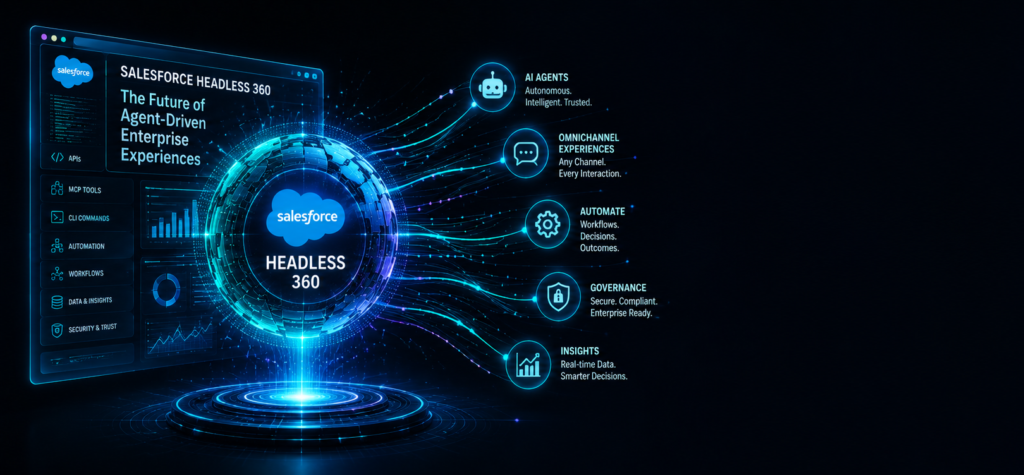
Announced at Salesforce TDX 2026, Headless 360 reimagines how businesses, developers, and AI agents interact with the Salesforce ecosystem. Rather than confining interactions to a traditional browser-based interface, Salesforce now exposes its platform capabilities as APIs, MCP (Model Context Protocol) tools, and CLI commands. In short, Salesforce is making the browser optional.
For IT leaders, developers, and Salesforce partners, this is a pivotal moment. This article breaks down what Headless 360 is, why it matters, and how it will reshape enterprise operations.
What Is Salesforce Headless 360?
Salesforce Headless 360 is a new architectural framework that decouples Salesforce’s business logic and data capabilities from its traditional user interface. The result is a platform where every core function — from record management to workflow automation — can be accessed programmatically, without requiring a human to navigate a dashboard.
“Everything on Salesforce is now an API, MCP tool, or CLI command.” — Salesforce.
This means AI agents, external applications, and custom developer tools can now interact directly with Salesforce. The platform shifts from being a tool that users log into, to a service that agents and applications can operate from anywhere.
In practical terms, AI agents powered by Headless 360 can:
- Create, read, update, and delete CRM records autonomously
- Trigger complex multi-step workflows without human intervention
- Resolve customer support cases and escalate when needed
- Retrieve contextual customer data in real time
- Generate reports and surface insights across channels
Why Salesforce Built Headless 360
To understand the significance of this launch, it helps to consider how enterprise software has traditionally been designed: around the human user. Employees log in, navigate menus, fill forms, and manually execute workflows. This model works well for human operators, but it creates friction for AI agents and automated systems.
AI agents do not use software the way humans do. They interact through APIs, structured tool definitions, and machine-readable workflows. As generative AI and autonomous agents have become increasingly capable, platforms built exclusively around human interfaces have begun to show their limitations.
Salesforce recognised this gap early. As Parker Harris, Co-Founder of Salesforce, explained during the TDX 2026 announcement, the goal was to fundamentally rebuild Salesforce for agents — not just for humans. Headless 360 is the direct outcome of that vision.
The Three Core Pillars of Headless 360
1. MCP Tools and Coding Skills
At the heart of Headless 360 is a comprehensive set of developer and agent-facing interfaces:
- 60+ MCP (Model Context Protocol) tools
- 30+ preconfigured coding skills
- 4,000+ APIs
- 220+ CLI commands
MCP acts as a standardised interface that allows AI models and coding agents to discover and use Salesforce capabilities dynamically. Developers can now work with compatible AI coding agents to access Salesforce orgs, read metadata, generate Apex code, create flows, manage deployments, and execute DevOps operations — all without touching the Salesforce UI.
2. Agentic Experience Layer
The second pillar is an entirely new experience layer designed for omnichannel, agent-driven interactions. Headless 360 allows Salesforce functionality to surface across virtually any interface:
- Slack and team collaboration tools
- WhatsApp and messaging platforms
- Voice interfaces and call centre systems
- Mobile applications
- Custom web applications and portals
For example, a customer support agent can resolve cases directly within Slack without ever opening Salesforce. A sales AI assistant can update opportunity records autonomously based on conversation context. A voice agent can retrieve a customer’s full history during a live call. The platform becomes embedded into workflows rather than confined within a browser tab.
3. Governance and Trust Controls
Greater autonomy demands greater oversight. Headless 360 introduces an enhanced governance layer that gives enterprises control over:
- Agent behaviour and permissions
- Runtime policy enforcement
- Security and access validation
- Workflow oversight and auditability
This is particularly important for regulated industries such as healthcare, financial services, insurance, and government, where compliance requirements are strict, and the risks of uncontrolled automation are significant. Salesforce has been deliberate in ensuring that enterprise-grade trust remains foundational even as agents gain more operational independence.
How Headless 360 Changes Salesforce Development
For Salesforce developers and architects, Headless 360 represents a meaningful shift in how solutions are designed and built.
Traditionally, Salesforce development centred on Lightning UI components, Apex code, page layouts, and flow automation — all ultimately serving a human user navigating the platform. With Headless 360, AI agents become primary consumers of platform capabilities. APIs and programmatic tools replace the UI as the primary interaction layer, and interfaces themselves become optional.
Developers must now design capabilities that can be consumed by humans, AI agents, external applications, and automation engines simultaneously. This introduces a more composable, service-oriented approach to Salesforce architecture.
According to Salesforce Developer Relations, the focus is shifting toward:
- System design and API strategy
- Agent orchestration and multi-system architecture
- Governance, security, and access management
- Quality engineering and observability
This is an opportunity for experienced Salesforce professionals to evolve their skill sets and position themselves at the forefront of agentic enterprise development.
Key Business Benefits
Faster Innovation Cycles
By decoupling business logic from the UI layer, teams can build capabilities once and deploy them across multiple channels simultaneously. This dramatically accelerates product development, automation rollout, and AI integration timelines.
AI-Native Enterprise Operations
Headless 360 positions Salesforce as an AI-native platform. Agents can execute workflows autonomously, coordinate processes, and access contextual data continuously — moving enterprises closer to intelligent automation at scale.
Omnichannel Engagement
Customers and employees increasingly operate across multiple environments. Headless 360 enables Salesforce experiences to surface wherever they are — in collaboration tools, voice systems, mobile apps, or AI assistants — creating genuinely frictionless engagement.
Developer Flexibility and Composability
Developers can now build with React, Next.js, external frameworks, and API-first architectures. Salesforce becomes a composable business infrastructure rather than a closed ecosystem, opening it to a much wider range of development patterns.
Real-World Use Cases
Intelligent Customer Support
AI agents can automatically resolve support cases, access full customer histories, trigger resolution workflows, and escalate complex issues to human agents — all without requiring support staff to log into Salesforce.
AI-Powered Sales Operations
Sales assistants can update CRM records, generate opportunity summaries, schedule follow-ups, trigger campaigns, and forecast pipeline activity through conversational interfaces or external tools, reducing administrative burden on sales teams.
Slack-Native Enterprise Workflows
Teams can interact with Salesforce directly from Slack — approving requests, accessing analytics, retrieving customer insights, and collaborating with AI agents — without context switching between applications. This alone can deliver measurable productivity gains.
Voice-Based Service Experiences
Voice agents can retrieve real-time customer data, assist call centre staff, automate response handling, and update records during live conversations, creating more intelligent and responsive service experiences.
Headless 360 and the Broader Agentforce Ecosystem
Headless 360 does not exist in isolation. It is a foundational layer within Salesforce’s broader AI strategy, deeply integrated with Agentforce — Salesforce’s platform for building and deploying AI agents across the enterprise.
Together, these components form what Salesforce calls the “Agentic Enterprise”:
- Data 360 provides contextual enterprise data
- Customer 360 delivers CRM workflows and business logic
- Agentforce manages and orchestrates AI agents
- Slack serves as the collaboration and engagement layer
- Headless 360 exposes everything programmatically
The goal is not to replace human workers, but to enable humans and AI agents to collaborate more effectively — each doing what they do best.
Challenges and Considerations
As with any major architectural shift, Headless 360 introduces challenges that enterprises must carefully plan for.
Governance Complexity
API-first architectures require robust permission models, validation rules, and runtime monitoring. Without strong governance, the flexibility of agent-driven operations can become a liability.
Organisational Readiness
Many Salesforce environments remain heavily reliant on UI-based administration. Moving toward agent-driven operations requires mature DevOps practices, clear API strategies, and a culture of operational discipline.
AI Trust and Oversight
Autonomous agents must operate within clearly defined boundaries. Organisations need human review processes, full auditability, and responsible AI governance frameworks to ensure that agent autonomy does not outpace organisational control.
What This Means for Salesforce Partners
For Salesforce consulting and implementation partners, Headless 360 creates significant new opportunities. Enterprises will require expert guidance to navigate this architectural shift — and those partners who develop deep expertise early will be well positioned to lead.
Key areas of demand will include:
- API-first Salesforce architecture design
- Agentforce implementation and agent orchestration
- DevOps modernisation and CI/CD strategy
- Omnichannel experience design and integration
- Governance frameworks and responsible AI implementation
As a Salesforce partner, we are already preparing to help our clients make this transition effectively — combining technical expertise with a clear understanding of the business outcomes that matter most.
Conclusion: The Future Is Headless
Salesforce Headless 360 is more than a new feature or product update. It represents a fundamental shift in how enterprise software is designed, consumed, and operated. By exposing Salesforce capabilities as APIs, MCP tools, and CLI commands, Salesforce is preparing the enterprise world for an AI-first future.
The implications are significant. Businesses that embrace this shift early will be positioned to move faster, serve customers more intelligently, and build more resilient operations. Those who delay risk falling behind as AI-native competitors gain ground.
Headless 360 signals that the era of the Agentic Enterprise is not on the horizon — it has arrived. Salesforce is leading that transformation, and for organisations and partners ready to evolve, the opportunity is substantial.