
By : Ajay Pratap Singh
From a billion-dollar acquisition to a Bengaluru call centre — the inside story of how Salesforce OmniStudio is quietly reshaping India’s telecom landscape
Part 1: The Platform That Changed Enterprise Software From the Inside Out
A Bet That Most People Missed
February 2020. Salesforce announced it was paying $1.33 billion to acquire a company called Vlocity — and the reaction from most of the tech world was, essentially, a shrug. The name meant little outside a narrow circle of enterprise professionals who had spent years watching Vlocity quietly become indispensable to some of the world’s most complex industries.
Vlocity had built something that generic CRM platforms had always struggled to deliver: software that actually understood the operational reality of vertical industries. A telecom operator managing tens of thousands of active service orders. A health insurer tracking claims across hundreds of provider networks. A utility company handling outage tickets, billing disputes, and field crew dispatch — all simultaneously. These were not problems a vanilla CRM could solve without years of painful customisation. Vlocity had already done that heavy lifting, out of the box.
When Salesforce absorbed Vlocity’s technology and rechristened it OmniStudio, it was not simply adding a product to a catalogue. It was choosing a fundamentally different philosophy about how enterprise software should be built — one where industry expertise is baked in from the ground up, rather than bolted on afterward.
What OmniStudio Actually Is
Strip away the marketing language and OmniStudio is, at its core, a visual development environment that lives natively inside Salesforce. It gives developers, admins, and even savvy business analysts the ability to construct sophisticated digital workflows — the kind that once required entire engineering teams — through configuration-driven tooling rather than hand-written code.
The platform organises itself around four interconnected capabilities, each with a distinct job:
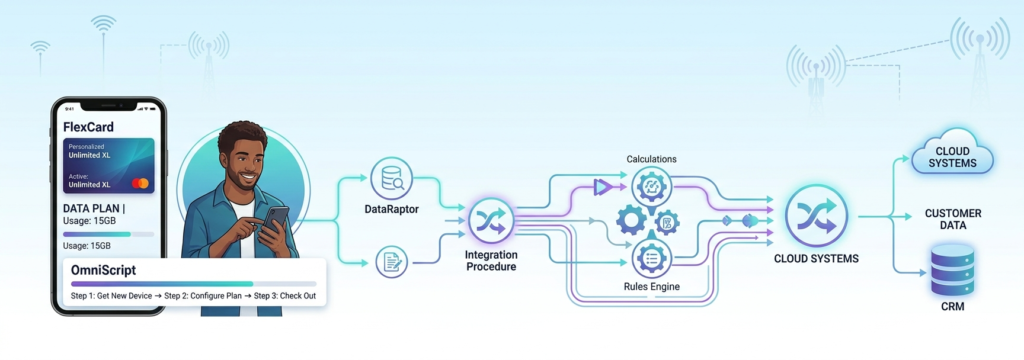
- FlexCards — Think of these as context-aware dashboards. A FlexCard doesn’t just display one record; it assembles information from wherever it lives — multiple Salesforce objects, external APIs, third-party systems — and renders it as a single, coherent view. What a FlexCard shows can change depending on the data itself: a flagged account looks different from a healthy one.
- OmniScripts — These are the guided journeys of OmniStudio. When a user needs to navigate a multi-step process — filing a claim, upgrading a plan, completing an onboarding — an OmniScript structures that journey stage by stage. It validates inputs in real time, branches based on selections, and pre-fills whatever it already knows, so nothing needs to be entered twice.
- Data Mappers — Enterprise data is messy. It lives across dozens of objects, formatted differently by different teams, updated at different frequencies. Data Mappers are the translation layer that pulls all of this apart and reassembles it into whatever shape a FlexCard or OmniScript needs — handling extraction, transformation, and write-back without a single line of query code.
- Integration Procedures — The hidden orchestrators. When an action inside Salesforce needs to trigger multiple external API calls simultaneously, apply business rules to the combined results, and return a single answer in under a second — that is an Integration Procedure’s job. It runs entirely server-side, which means no round-trip delays and no unnecessary load on the client.
These four capabilities are not independent features that happen to share a name. They are designed to function as a connected system: Data Mappers feed FlexCards with clean data; Integration Procedures power the backend logic that OmniScripts rely on; FlexCards surface action buttons that trigger OmniScripts. Together they cover the full arc of any enterprise digital experience — from the first API call to the final screen the user sees.
The Industries That Needed This Most
To understand why OmniStudio resonated so immediately with certain sectors, consider what it actually costs to service a customer in a complex industry. Take a postpaid telecom account. A single customer interaction — say, a plan change — might require confirming identity, checking network eligibility at the customer’s address, validating billing status, reviewing contract terms, calculating proration, updating the service record, triggering a provisioning order, and sending a confirmation. That is eight distinct operations, potentially spanning four or five different systems, that an agent must complete accurately while a customer waits on the line.
Before platforms like OmniStudio, handling this required either a massive amount of custom development — bespoke code stitching systems together — or agents who had memorised a labyrinthine process across multiple tabs. Neither option scaled well. Errors were common. Training new agents was expensive. And any change to the underlying process meant another development cycle.
OmniStudio changed the economics of this problem. The same eight-step operation can be encoded into an OmniScript that guides the agent through each decision point, fires off the necessary Data Mappers and Integration Procedures behind the scenes, and surfaces results without the agent needing to understand what is happening under the hood. A process that once took 15 minutes and required specialist knowledge can now be completed in under 3 minutes by a new hire on their first week.
From Industry Tool to Strategic Cornerstone
Salesforce had been selling to enterprise customers for two decades before the Vlocity acquisition. But there were entire verticals — communications, government, financial services, energy and utilities — where its generic platform had always felt like a compromise. Customers in these sectors needed software that spoke their language from day one: a data model that understood service contracts, not just sales opportunities; workflows that reflected regulatory requirements, not just pipeline stages.
OmniStudio gave Salesforce that capability. The Industry Clouds it had been marketing for years — Communications Cloud, Health Cloud, Financial Services Cloud — suddenly had an engine behind them that could actually deliver on the promise of industry-specific software. Pre-built process templates, compliant data models, and configurable guided experiences meant a telecom operator could go from signed contract to live deployment in a fraction of the time that custom development would have required.
For customers, this translated into lower implementation costs, faster time-to-value, and experiences that felt genuinely tailored — not like a horizontal platform retrofitted to do a vertical job. For Salesforce, it unlocked deal sizes and market segments that had previously been out of reach.
Why Low-Code Is Not a Compromise — It Is a Strategy
There is a persistent assumption in enterprise technology that low-code tools are for simpler problems — that anything genuinely complex still requires hand-crafted code. OmniStudio challenges that assumption directly.
Its Integration Procedures can orchestrate parallel API calls across multiple external systems with conditional logic and error handling built in. Its Data Mappers can perform aggregations, unit conversions, and date transformations across dozens of Salesforce objects in a single operation. Its OmniScripts can branch across dozens of conditional paths, pre-validate against external systems mid-flow, and render completely different interfaces depending on what data they receive. None of this is toy territory.
What low-code actually means in OmniStudio’s context is not that the problems are simpler — it is that the expertise required to solve them has fundamentally shifted. A process that previously needed a senior developer now needs a well-trained business analyst. A change that once required a sprint now takes an afternoon. As enterprises face growing pressure to do more with leaner teams and tighter timelines, that shift is not a nice-to-have. It is a survival mechanism.
Whether you first encounter OmniStudio as a curious reader trying to understand what powers those seamless enterprise portals, or as a practitioner deciding whether to bet your next project on it — the story is the same. This is a platform that took a genuine industry problem seriously, built something that actually solved it, and in doing so, changed what enterprise software can look like.
Part 2: Inside the Call — OmniStudio at Work in India’s Telecom Industry
9:14 AM, Bengaluru
At a customer operations centre serving one of India’s major telecom providers — the kind that handles millions of postpaid subscribers across the country — an agent named Priya Sharma is already on her 23rd call of the morning. On the other end of the line is Arjun Mehta, a 34-year-old software consultant from Koramangala. He is not happy.
His 5G speeds have been throttling for three days. His last bill came in at ₹1,499 — higher than expected. He wants to upgrade to a plan that stops throttling him, but only if it doesn’t reset his contract clock. He is seven months away from contract renewal and the associated device upgrade benefit.
Arjun’s call is not unusual. It is the most common category of inbound contact at most postpaid telecom service centres: a billing question layered on top of a technical frustration layered on top of a commercial request. The agent handling it needs to navigate multiple systems accurately and resolve the call before the customer’s patience runs out. This is exactly the environment OmniStudio was built for.
What Priya Sees: The FlexCard
Priya types Arjun’s mobile number into the search bar. By the time the account resolves, a FlexCard has loaded — not a flat record view, but a live dashboard that has simultaneously reached into the Account, ServicePlan, Usage, BillingStatement, and open Case objects and assembled a unified picture.
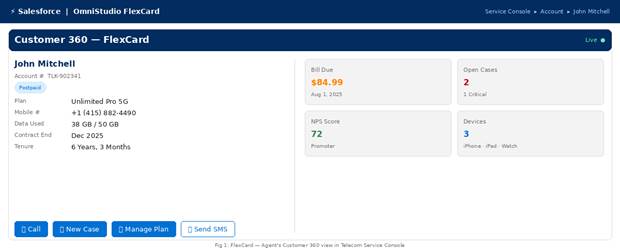
Fig. 1 — FlexCard: Priya’s unified Customer 360 view, assembled in real time from five Salesforce objects the moment she pulls up Arjun Mehta’s account
In under three seconds, Priya has a complete operational picture:
- Arjun is on Unlimited Pro 5G and has consumed 38 GB of his 50 GB monthly allocation — which immediately explains the throttling, without asking.
- His current bill of ₹1,499 is unpaid and overdue — flagged in amber. The billing spike is a one-time roaming charge from a recent trip, visible in the billing detail sub-card.
- Two open support cases on the account — one marked Critical, related to a network complaint logged four days ago and unresolved.
- Arjun’s network tenure: six years and four months — placing him in the top retention priority tier.
None of this required Priya to ask a single question, open a second tab, or transfer to billing. She knows Arjun’s situation more completely than he probably does — and that immediately shifts the conversation from reactive to consultative.
Field note: The data Priya sees is assembled by a Data Mapper Extract running silently in the background — drawing from five separate Salesforce objects and returning a single, clean JSON payload that the FlexCard renders. What looks like a simple dashboard is actually a real-time multi-object aggregation. From the agent’s standpoint, it is just the information she needs, exactly where she needs it.
Navigating the Upgrade: The OmniScript
Priya confirms the roaming charge with Arjun. She then addresses the plan upgrade. He qualifies. She clicks “Manage Plan” from the FlexCard’s action bar, and an OmniScript opens — a four-step guided workflow that has already pre-loaded Arjun’s account details, current plan, and mobile number. Priya does not type a single character to start the flow.
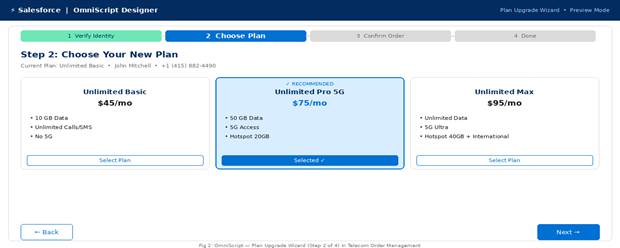
Fig. 2 — OmniScript: The Plan Upgrade Wizard at Step 2, where Arjun’s usage profile and tenure have triggered an automatic recommendation
The OmniScript walks Priya through four structured stages:
- Identity Verification: The script prompts for Arjun’s date of birth and registered email. These are validated against Salesforce records the moment they are entered — not after submission. A mismatch halts the flow immediately, before any account change is processed.
- Plan Selection: Three options appear side by side. Because Arjun is approaching his data cap and holds six-plus years of tenure, the OmniStudio business rules engine has pre-tagged the ₹1,999/month Unlimited Max plan as the recommended upgrade — without Priya consulting a comparison sheet.
- Order Confirmation: A summary screen shows the prorated charge for the remaining billing cycle (calculated automatically), the new monthly amount, and the contract end date — unchanged, as Arjun requested. No manual arithmetic. No separate billing query.
- Completion: On confirmation, the OmniScript triggers a Data Mapper Load that writes the new plan to the ServicePlan record, then fires an Integration Procedure that calls the SMS gateway API and delivers a confirmation to Arjun within 15 seconds. A 30-day retention check-in task is auto-created in Priya’s queue.
The entire resolution — from account pull-up to confirmation SMS — takes four minutes and twenty seconds. The industry benchmark for the same interaction type, handled manually across multiple systems, is typically 12 to 18 minutes. The difference is not Priya working faster. It is the system eliminating every unnecessary decision, every redundant data entry, every tab switch from her path.
Field note: OmniScripts encode the organisation’s institutional knowledge — the right questions in the right order, the right validations at the right moments — directly into the workflow. A new agent who joined three weeks ago follows the same process as a ten-year veteran. Compliance and consistency are structural properties of the script, not disciplines that require supervision.
The Invisible Layer: Data Mappers at Work
Every piece of information that appeared on Priya’s screen without her asking for it — Arjun’s data usage, his bill amount, his tenure, his open cases — was assembled by a Data Mapper. These are the silent intermediaries of OmniStudio: tools that reach into Salesforce’s data model, extract whatever fields are needed, reformat them for the component that will display them, and return a clean result — all without touching a single line of query code.
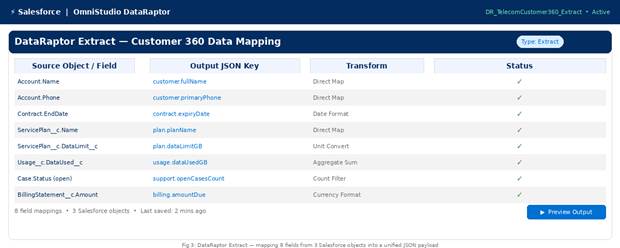
Fig. 3 — Data Mapper Extract: eight fields mapped from five Salesforce objects into a unified JSON output powering Arjun’s Customer 360 FlexCard
The Data Mapper behind Arjun’s FlexCard draws from five distinct objects: Account, ServicePlan, Usage, Case, and BillingStatement. Each has different field names, different update cadences, and different ownership across the organisation’s teams. The Data Mapper reconciles all of this into a single payload — converting data units, formatting currency in rupees, counting only open cases — before handing it to the FlexCard to render.
In a telecom context, this matters enormously. Customer data at large operators can span dozens of custom objects and external data sources, each maintained by different teams on different schedules. Surfacing a coherent picture from that complexity is not trivial — but with Data Mappers, it becomes a configuration task that a business analyst can own, rather than a development project that requires an engineering sprint.
Field note: Data Mappers come in four variants — Extract (read from Salesforce), Transform (reshape data without persisting it), Load (write back to Salesforce), and Turbo Extract (a performance-optimised variant for simple reads). In Arjun’s scenario, an Extract assembled his profile; a Load updated his ServicePlan at the end of the OmniScript. Two Data Mappers. Zero Apex classes.
The Check Nobody Sees: Integration Procedures
Just before Priya clicked Confirm on Step 3, something happened that neither she nor Arjun was aware of. An Integration Procedure named IP_PlanEligibility_Validate had already fired — triggered automatically by the OmniScript when Arjun selected the Unlimited Max plan. In a single server-side transaction, it ran three checks in parallel:
- A call to the network infrastructure API confirming that 5G service is active at Arjun’s registered address in Koramangala, Bengaluru — down to the specific pincode.
- A query to the billing platform verifying that no payment block or credit hold is active on the account that would prevent a plan change.
- A check against the plan inventory system confirming that Unlimited Max is available for new subscriptions in the Karnataka telecom circle.
All three returned green. Priya saw a simple confirmation banner and moved on. Had any check failed — say, if Arjun’s pincode were in a 4G-only zone — the OmniScript would have automatically suppressed the 5G plan from the selection screen. The wrong option would simply never have been presented.
This is what Integration Procedures are built for: real-time cross-system validation that runs before a decision is made, not after a bad one has already been processed. In the telecom industry, where plan-location mismatches are a significant driver of post-sale complaints and early churn, eliminating bad upgrades at source has measurable commercial value.
Field note: Because Integration Procedures run entirely on the server side, they add no visible latency to the user experience. The three API calls fired, resolved, and returned results while Arjun was still reading the plan comparison screen. He noticed nothing. Priya noticed nothing. The system handled it.
Five Minutes Later
Arjun Mehta’s call closes at 9:18 AM. He has a new plan at ₹1,999 per month, his contract dates are intact, the roaming charge has been explained, and a confirmation SMS arrived before he even said goodbye. The Critical open case from four days ago has been flagged and routed to the network team.
Priya logs the call and moves to number 24. She did not open a second application. She did not escalate to billing. She did not consult a knowledge base article or ask a senior colleague. Everything she needed — the data, the process, the validation, the communication — was delivered through four OmniStudio components working in concert: a FlexCard that assembled the picture, an OmniScript that structured the journey, Data Mappers that handled the data logistics, and an Integration Procedure that validated the decision before it was made.
In an industry that measures success in fractions — fraction-of-a-percent churn rates, fractional improvements in first-call resolution, seconds shaved from average handle time — this kind of operational precision is not incidental. It is the difference between a telecom brand that customers recommend and one they leave at the first opportunity.
OmniStudio does not make that difference on its own. But it gives the people who do — agents like Priya — the tools to make it consistently, at scale, across every call in the queue.
Conclusion: The Call That Represents a Million Others
Arjun’s call lasted just over four minutes. But the story behind those four minutes stretches back to a $1.33 billion acquisition, a decade of hard-won industry expertise, and a fundamental rethinking of how enterprise software should serve the people who depend on it every day. That is the arc of OmniStudio — from a corporate boardroom decision in San Francisco to a call centre desk in Bengaluru, where a frustrated customer became a satisfied one — not because the agent was exceptional, but because the system made it possible for any agent to be exceptional.
What this article has traced — from OmniStudio’s origin story through to its four core components and finally into a live telecom scenario — is not just a product walkthrough. It is a portrait of what happens when technology is built around the problem, not around the tool. FlexCards did not exist because someone wanted to build a card component. They exist because agents were drowning in tabs. OmniScripts did not exist because guided workflows are technically interesting. They exist because institutional knowledge was leaking out of organisations every time an experienced agent left the floor. Data Mappers and Integration Procedures exist because real-world data is messy, distributed, and unforgiving — and pretending otherwise costs businesses dearly.
For India’s telecom industry specifically, the stakes could not be higher. With over a billion mobile subscribers, some of the world’s most competitive per-gigabyte pricing, and a customer base that switches providers with very little friction, the quality of a single service interaction is not a minor detail — it is a retention event. Arjun staying on his network after a frustrating week is not a given. It is earned, call by call, interaction by interaction. Platforms like OmniStudio are how operators scale that earning process across millions of subscribers simultaneously.
The next time you call your telecom provider and the agent seems to already know why you’re calling — already has your usage data, already knows your plan history, already walks you through the right options without putting you on hold — there is a reasonable chance that OmniStudio is the silent reason why. Not a visible feature. Not a branded experience. Just a platform doing its job so well that you never have to think about it — which, in enterprise software, is the highest compliment there is.