
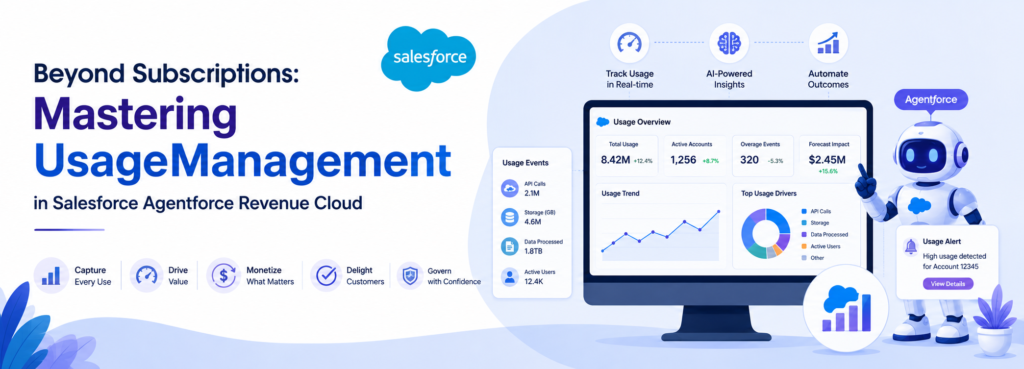
How Agentforce Revenue Management reshapes the way businesses model, sell, track, and bill for consumption-based products
By : Tanishka Rajawat
For decades, the subscription model has been the default engine of recurring revenue. A customer pays a fixed fee every month or year, and in return receives unrestricted access to a product or service. It is predictable, easy to forecast, and simple to bill. But that simplicity is also its biggest weakness. Not every customer uses a product the same way, and forcing everyone into a flat-rate box either overcharges light users or undercharges heavy ones. Telecom carriers, cloud storage providers, API platforms, and software vendors have all discovered that the next frontier of monetization is not the subscription itself, but what happens after the subscription begins: how much a customer actually consumes.
This is where consumption-based, or usage-based, pricing enters the picture. Instead of a flat fee for unlimited access, customers pay in proportion to what they actually use, whether that is gigabytes of storage, minutes of call time, number of API calls, or text messages sent. Salesforce has built a purpose-made engine for this model inside Agentforce Revenue Management, formerly known as Revenue Cloud, called Usage Management. This article takes a deep look at what Usage Management is, how it operates within the broader revenue lifecycle, the core building blocks that make it work, and why organizations moving toward consumption pricing should care.
The Trouble With Pricing What You Cannot See
Imagine a company offering up to 100 GB of cloud storage per customer every month. One account barely touches 20 GB, while another blows past the limit within days. Charging both customers the same amount is neither fair nor sustainable, yet tracking individual consumption accurately, at scale, is far from trivial.
In practice, many organizations still handle this manually. Billing teams pull network or system reports to calculate what each customer consumed. Support teams manually notify customers as they approach their limits. Finance teams manually apply one-off overage charges when a customer exceeds their allowance and needs a top-up. Every one of these steps is slow, error-prone, and disconnected from the others. The result is delayed invoices, billing disputes, and a poor customer experience — the opposite of what a modern, consumption-friendly business needs.
Agentforce Revenue Management addresses this gap directly through its Usage Management capability, which brings structure, automation, and transparency to the entire consumption lifecycle.
What Usage Management Actually Does
Usage Management is the set of tools inside Agentforce Revenue Management that lets a business define, measure, price, and invoice consumption-based products with precision. Whether the offering is cloud storage, transactional software access, or digital downloads, the objective is the same: make sure customers get exactly what they paid for, make sure the business accurately captures what was consumed, and make sure billing reflects real usage rather than estimates or guesswork.
Rather than functioning as a bolt-on utility, Usage Management includes a purpose-built selling experience for consumption products that is woven directly into the standard quote-to-order process. Once a customer starts consuming a product, the system converts raw usage data into invoice-ready summaries, so that billing teams are working from clean, structured numbers instead of chasing spreadsheets.
How Usage Management Connects to the Rest of the Platform
Usage Management does not operate in isolation. It is deliberately woven into the core pillars of Agentforce Revenue Management — Configure, Price, Quote, Asset Management, and Billing — so that a consumption product behaves consistently from the moment it is quoted to the moment it is paid for.
Quoting Through CPQ
When a sales representative builds a quote, consumption-based products can be selected straight from the catalog. The quote automatically reflects what the customer is entitled to at no extra cost, along with the rate that will apply once that entitlement is exhausted. Because the underlying usage grants, included amounts, and overage rates are already defined in the system, reps do not need to manually calculate anything — although rates can still be adjusted or negotiated where needed, giving sales teams a defensible starting point rather than a blank slate.
Assets and the Digital Wallet
Once an order for a consumption product is activated, the platform automatically generates a corresponding asset, and alongside it, a wallet. The wallet functions as a live ledger of that customer’s entitlements, consumption, and remaining balance. This single mechanism carries the customer through renewals, rollovers, amendments, and cancellations without anyone needing to reconcile numbers by hand. Every downstream record — from the original order to the resulting asset — is linked, so pricing details and usage terms remain consistent throughout the customer’s lifecycle.
Consumption and Billing
As customers use the product, the system ingests raw usage events through transaction journals. At the end of a billing period, this raw data is aggregated, matched against the applicable rate cards, and converted into an overage charge if the customer exceeded their included allowance. The resulting numbers are then handed off to the billing engine for invoicing. This closes the loop from quote to cash without requiring finance teams to manually stitch together usage reports and billing spreadsheets.
The Five Building Blocks of Usage Management
A consumption-based product moves through a fairly predictable lifecycle: it has to be defined, priced, sold, tracked, and made visible to both the business and the customer. Usage Management supplies one dedicated component for each of these stages.
1. Usage Modelling
This is where everything begins. Usage Modelling is where a business defines what is actually being consumed and how it will be measured. Three concepts sit at the center of this stage.
- Usage resources — the specific, measurable things a customer consumes, such as text messages, gigabytes of data, or call minutes. Each one can be sold as part of a bundle or offered as a standalone add-on.
- Units of measure — the way usage is quantified, for example count, GB, or minutes, grouped into classes that keep conversions and calculations consistent.
- Product usage grants — the entitlement itself, describing how many units a customer receives, for how long, and under what rollover or expiration rules.
2. Rate Management
Once a usage product is modeled, the business needs a way to turn consumption into an actual price. Rate Management supplies configurable rate cards and rate card entries that define flat or tiered pricing per usage resource, along with rating procedures that apply this logic automatically. This keeps overage charges and discounts consistent across every customer, while still giving the business room to adjust pricing by region, customer segment, or contract terms.
3. Usage Selling
With pricing rules in place, consumption products can be sold with full transparency. Usage Selling gives sales reps upfront visibility into rating details while they are quoting, letting them bundle usage grants with base products, offer them as optional add-ons, or tailor entitlements to a specific customer’s contract — all inside the familiar guided-selling experience reps already use for other products.
4. Wallet Management
Every purchased usage resource generates a wallet tied to the customer’s account, and Wallet Management is the dashboard layer that surfaces this data. It tracks drawdowns — how much of a grant has been consumed and deducted — and manages rollover or refresh policies that decide whether unused allowances carry into the next period or reset. The result is a real-time view that prevents both the business and the customer from being caught off guard by an unexpected overage.
5. Consumption Management
The final stage turns raw activity into billing-ready insight. Consumption Management captures every usage event through a transaction journal, aggregates that data into usage summaries using methods such as sum or peak measurement, converts those summaries into rated monetary values, and finally produces liable summaries — the exact amount owed by the customer — which is passed along to billing for invoicing.
Who Actually Uses These Tools
Usage Management is not the domain of a single team. Several roles interact with it throughout a product’s lifecycle, each relying on a different piece of the system.
- Product Designers define the resources and entitlements using Usage Modelling.
- Pricing Designers build rate cards and rating logic through Rate Management.
- Sales Representatives quote and sell consumption products using Usage Selling.
- Usage Designers turn raw consumption data into structured, reportable information through Consumption Management.
- Account Executives monitor customer usage and remaining balances via Wallet Management and Consumption Management together.
- Customers themselves rely on Wallet Management to see their own consumption and avoid billing surprises.
Each of these personas depends on the others. A pricing designer’s rate card is meaningless without a product designer’s usage resource, and a sales rep cannot quote accurately without both being in place. The system is built around this interdependence.
Turning Theory Into Practice: Resources, Grants, and Product Mapping
To see how these concepts come together in a real configuration, consider a mobile carrier building a Cell Phone Plan product. The plan needs to track three distinct forms of consumption: text messages, mobile data, and call minutes. Each of these becomes its own usage resource, created with a name, a unique code, a category, and a default unit of measure — count for text messages, gigabytes for data, and minutes for calls.
Once the usage resources exist, they need to be connected to the actual product. This is handled through a junction record called a Product Usage Resource, which links the Cell Phone Plan to each of its three consumption types. Because a single product can draw on multiple usage resources, and a single usage resource can be reused across several products, this junction layer keeps the many-to-many relationship clean and manageable.
The final step is defining how much of each resource a customer receives at no additional cost. This is the Product Usage Grant — for example, 4,000 included text messages, 2 GB of data, and 100 minutes of calls, each with its own validity period, rollover policy, and refresh policy that determines whether unused units carry into the next billing cycle or reset. Only once these records are reviewed and activated does the Cell Phone Plan become fully configured to track consumption and automatically apply the correct included allowances.
This same pattern — resource, product mapping, and grant — repeats regardless of industry. A software company tracking API calls, a utility company tracking energy units, or a healthcare platform tracking data storage would all follow the identical structure, simply substituting their own resources and quantities.
A Real-World Example: How InfinitraBytes Built Its Cell Phone Plan
To see these ideas applied outside the abstract, it helps to walk through a scenario Salesforce uses in its own hands-on training. InfinitraBytes, an electronics and solutions provider, recently adopted Agentforce Revenue Management. Liam Hoko, the company’s usage admin, is tasked with turning a new Cell Phone Plan into a fully working consumption-based product — one that tracks texts, data, and call minutes, and grants each customer a fair amount of included usage before overage charges kick in.
Before Liam can configure resources and grants, he first has to decide what role the Cell Phone Plan itself plays in the pricing structure. Agentforce Revenue Management calls this the usage model type, and it determines whether a product is the core offering, an add-on, or a spending commitment. Two of these model types form the base of almost any consumption setup.
- Anchor — the primary product a customer buys, such as the Cell Phone Plan itself. This is the product that grants access to the underlying service.
- Pack — a supplementary product that adds more of a consumable resource on top of an Anchor. If the Cell Phone Plan’s Anchor tier includes 2 GB of data, a customer who regularly runs over that limit could purchase a Pack that adds another 5 GB without changing their base plan.
Liam sets the Cell Phone Plan’s usage model type to Anchor, since it is the primary subscription customers buy into. He then confirms that the product is already linked to a Term Based – Monthly selling model with a list price of $100, meaning every customer pays a flat $100 a month simply to access the plan, before any usage-based grants or overages are applied on top.
Beyond Anchor and Pack, Agentforce Revenue Management also supports three commitment-based model types, useful when a business wants to trade predictability for a better rate. These are worth understanding even though Liam’s Cell Phone Plan does not use them, because they show how far usage-based pricing can flex.
- Token Commitment — a customer prepays for a pool of flexible tokens that can be spent across multiple products or services, for example a balance of 50,000 tokens where each token might equal 10 API calls or 1 GB of archive storage.
- Monetary Commitment — a customer guarantees a minimum spend over a set term in exchange for a discount, for example committing to $25,000 in processing fees over twelve months to unlock a 10 percent rate reduction, with any shortfall still billed at the end of the term.
- Quantity Commitment — a customer guarantees a minimum volume of usage rather than a dollar amount, for example agreeing to at least one million support contact hours a year, and still being billed for that minimum even if actual usage comes in lower.
Seeing the Cell Phone Plan through this lens makes the earlier walkthrough of usage resources and grants click into place. The $100 Anchor subscription is the entry point; the text, data, and call grants are the included usage layered on top of it; and if InfinitraBytes ever wanted to sell additional data as a standalone top-up, a Pack product would be the natural way to offer it. This is precisely the kind of layered configuration that lets a single consumption-based product support very different customer behaviors without InfinitraBytes having to build a separate pricing model for each one.
Digital Wallet: Giving Customers a Window Into Their Own Usage
While Wallet Management inside Usage Management gives internal teams visibility, Salesforce Digital Wallet extends a similar experience directly to customers and account teams as a lightweight, near real-time consumption dashboard. It applies to Digital Wallet-enabled products, where an organization purchases either a bucket of credits to draw down over time or a fixed capacity, such as data storage, that must be managed within a limit.
Digital Wallet organizes related usage types into containers called cards. If the same product appears across multiple active contracts for an organization, Digital Wallet pools those entitlements onto a single card and automatically draws down usage from whichever contract is set to expire first — sparing customers from having to manually manage overlapping agreements. Each card offers a quick, skimmable summary of what has been used and what remains, and a linked Consumption Insights page provides charts that break usage down by day, time period, and usage subtype.
To reinforce this visibility, the primary billing contact at an organization automatically receives a Monthly Account Summary email recapping the previous month’s consumption for every contract that includes a usage-based product. This is a summary for awareness rather than an official invoice — if numbers ever conflict, the actual invoice takes precedence. Together, these tools mean customers rarely have to ask, “how much have we used so far?” because the answer is already sitting on their dashboard.
Why This Matters for the Business
The value of Usage Management extends well beyond IT convenience. It directly influences operational cost, revenue capture, and customer trust.
Operational Efficiency
By automating tracking, summarization, and rating, Usage Management removes a large share of manual work from finance and billing teams. Pricing rules live in configurable rate cards rather than spreadsheets, which means updates can be rolled out without a development cycle, and invoicing moves faster because the underlying calculations are already done.
Scalability
Built on the Salesforce Platform with an API-first design, the system is engineered to absorb large volumes of usage data and a growing catalog of consumption products without a drop in performance. New usage-based products, whether metered by data, API calls, or transaction count, can be configured and scaled as demand grows.
Increased Revenue Capture
Every unit of consumption that is tracked accurately is revenue that no longer slips through the cracks of manual processes. Overage charges are applied automatically and consistently, and sales teams can use historical consumption patterns to forecast customer needs and shape future quotes.
Customer Transparency and Trust
When customers can see, in near real time, exactly what they have consumed and what they still have left, billing disputes fall away. Customers are billed only for what they actually used, and they can trace exactly how that number was calculated.
Flexibility in Monetization
Perhaps most importantly, Usage Management frees a business from the binary choice between one-time sales and flat subscriptions. Organizations can build pay-as-you-go offers, multi-tiered rate plans, and hybrid models that combine a base subscription with metered overages, matching pricing far more closely to how customers actually derive value from a product.
Closing Thoughts
Subscriptions built the recurring revenue economy, but they were never designed to reflect how unevenly customers actually consume a product. Usage Management inside Agentforce Revenue Management gives businesses a structured, automated way to move past flat-rate assumptions and price based on real consumption — from the moment a usage resource is defined, through the sales quote, all the way to the final invoice. Combined with tools like Digital Wallet that put consumption data directly in front of customers, the platform closes the gap between what a business sells and what a customer actually experiences. For any organization eyeing consumption-based pricing as its next growth lever, this is the infrastructure that makes it operationally realistic rather than a spreadsheet-driven guessing game.